
Where Did Breathwork Come From? The History & Evolution of Breathwork

Breathwork: An Ancient Practice for a Modern Nervous System
Breath is the first rhythm we arrive with.
Before language, before identity, before story — there is breath.
It is the first thing we do when we enter this world, and one of the final things we release when we leave it. It is so constant that we often forget it is there. And yet, the breath is quietly shaping every moment of our lives.
How we breathe influences how we feel, think, respond, rest, connect, create, and move through the world.
When we are stressed, the breath often becomes shallow, tight, and held. When we feel safe, it deepens. When emotion rises, the breath changes. When the body braces, the breath often braces with it.
This is why breathwork is so powerful. It gives us a direct doorway into the nervous system. Not through force. Not through overthinking. Not through trying to talk ourselves into feeling differently. But through the body.
Through rhythm.
Through sensation.
Through presence.
Through the ancient intelligence of the breath.
What Is Breathwork?
Breathwork is the intentional practice of using the breath to influence your physical, emotional, mental, energetic, and nervous system state.
Most of the time, breathing happens automatically. We do not have to think about it for it to continue. But the breath is also one of the few functions in the body that can be both unconscious and conscious.
This means we can work with it.
We can slow the breath to support regulation.
We can deepen the breath to reconnect with the body.
We can use rhythm to move emotion.
We can use awareness to come back into presence.
Some breathwork practices are gentle and restorative. They support relaxation, grounding, and nervous system settling. Others are more active and expressive. They can support emotional release, body awareness, expanded insight, and the movement of stored tension or survival energy.
In my work, breathwork is about listening. It is about creating a safe enough space for the body to soften, express, release, reorganize, and return.
Why the Breath Matters
The breath is not separate from the nervous system. Every breath sends information to the body.
A fast, shallow breath can communicate urgency. A slow, steady breath can communicate safety. A held breath may signal bracing, protection, fear, grief, or overwhelm.
The body is always listening.
This is why breathwork can be such a powerful support for stress, anxiety, emotional processing, trauma integration, and capacity building.
Because we are not just changing the breath. We are changing the signals being sent through the body. We are giving the nervous system a different experience of itself.
For people who live in chronic stress, high responsibility, caretaking, leadership, trauma histories, or constant output, this matters deeply. Because many people are not simply tired.
They are dysregulated.
They are bracing.
They are living in a body that has been trained to stay ready for the next thing.
Breathwork can become a practice of interrupting that pattern and returning to something steadier, more grounded, and more alive.
Where Did Breathwork Come From?
The conscious use of breath is not new.
Long before breathwork became popular in modern wellness spaces, cultures across the world understood the breath as a bridge between body, mind, spirit, and healing.
In yogic traditions, pranayama has been used for thousands of years to direct the flow of prana, or life force. These practices were designed to steady the mind, support meditation, regulate energy, and deepen connection between body and spirit.
In Taoist practices, breath has long been connected to the cultivation of chi — the vital energy that animates the body. Breathing practices were used to support vitality, balance, longevity, and internal harmony.
Indigenous and ceremonial traditions around the world have also worked with breath, rhythm, sound, movement, and altered states as part of healing, ritual, release, and connection to the unseen.
Across these traditions, the breath has never been understood as only mechanical.
It has been understood as sacred.
A pathway into presence.
A regulator of energy.
A bridge between the seen and unseen.
A way of returning to what is most alive within us.
The Modern Evolution of Breathwork
In more recent decades, breathwork has continued to evolve through modern therapeutic, somatic, and consciousness-based approaches.
Some methods, such as the Buteyko Method, focus on gentle breathing, carbon dioxide tolerance, and respiratory regulation.
Others, such as Rebirthing Breathwork and Holotropic Breathwork, brought attention to the use of connected breathing, music, and expanded states of awareness to support emotional release, insight, and healing.
More recently, somatic approaches to breathwork have emphasized the body’s wisdom — paying attention not only to the breath itself, but to sensation, movement, emotion, impulse, and the nervous system responses that arise during practice.
This is where my own work lives. At the intersection of science and soul.
The breath is both physiological and sacred.
It affects oxygen, carbon dioxide, heart rate, and nervous system state.
It also opens the door to emotion, memory, intuition, meaning, and the parts of ourselves that often live beneath language.
This is why I do not see breathwork as just a wellness trend. I see it as a profound practice of reconnection.
How Breathwork Supports the Nervous System
Breathwork works because the breath and nervous system are in constant conversation.
When we shift the breath, we influence the body.
A slower breath can help the system settle.
A fuller breath can bring awareness back into the body.
A connected breath can support emotional movement.
A conscious pause can create space between stimulus and response.
Depending on the style of breathwork, the practice may support:
nervous system regulation
stress reduction
emotional processing
tension release
body awareness
increased energy
mental clarity
capacity building
connection to intuition
integration after difficult experiences
For some people, breathwork feels calming and grounding. For others, it may bring emotion to the surface. This is not a problem. It is often the body finally having enough space to express what has been held. That is why safe facilitation matters.
Breathwork should not be about overwhelming the system or chasing catharsis. Especially for people with trauma histories, the goal is not to force the biggest release possible.
The goal is to build capacity.
To move at a pace the body can integrate. To support the nervous system without flooding it. To create enough safety for what has been held to begin moving in a way that feels supported.
Why Practice Breathwork?
People come to breathwork for many reasons.
Some come because they feel anxious, overwhelmed, disconnected, or stuck in their heads.
Some come because they are carrying grief, stress, tension, or emotion they do not know how to move.
Some come because they are high-functioning on the outside but exhausted underneath.
Some come because they want to feel more connected to their body, intuition, creativity, or inner wisdom.
And some come because they are craving a space where they do not have to perform, explain, or hold everything together.
Breathwork can support you in returning to yourself.
Not by fixing you. But by helping you feel what is here, listen to what your body is saying, and reconnect with the parts of you that have been quieted by stress, survival, or disconnection.
In this way, breathwork is about relationship.
Your relationship with your body.
Your relationship with your emotions.
Your relationship with your nervous system.
Your relationship with your own aliveness.
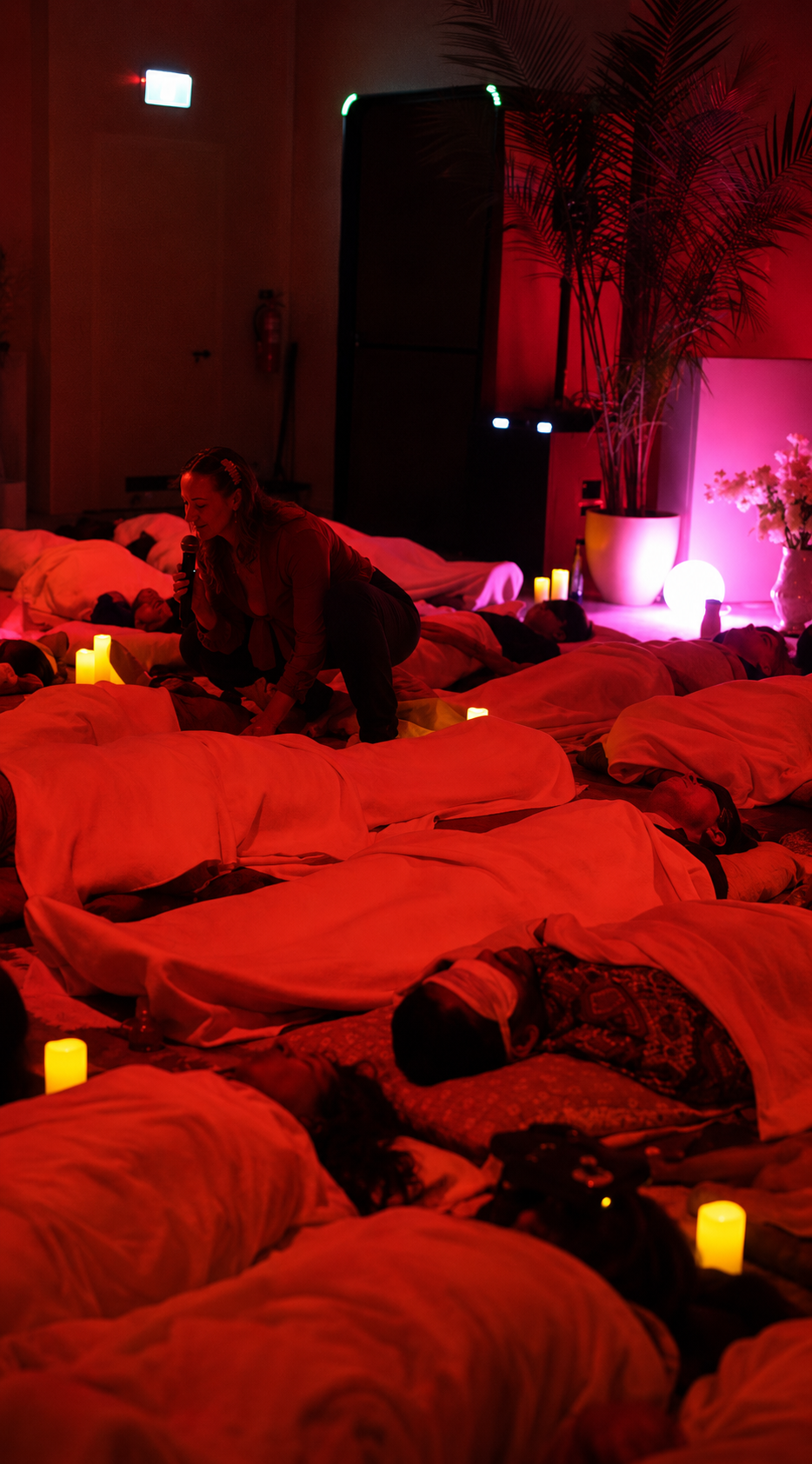
What Happens in a Breathwork Session?
Every breathwork session is slightly different, depending on the intention, the group, and the needs of the body that day.
In my sessions, we begin by arriving slowly.
We ground. We orient. We create safety. We take time to notice the body before asking anything of it.
From there, I guide you into a breath pattern that supports the intention of the session. This may be gentle and regulating, or it may be more active and expressive.
Throughout the practice, you are invited to stay connected to your body, your sensations, your emotions, and your own pacing.
Music, guided facilitation, body awareness, and spacious integration are often woven into the experience.
After the breathwork, there is time to rest, feel, journal, reflect, and let the body absorb what has moved.
This integration matters. Because the release is not the whole healing. The integration is where the body learns that it can move through intensity and return to safety again.
Breathwork as Part of My Offerings
Breathwork is one of the core ways I support people in coming back to themselves.
It weaves naturally with my work in Somatic Psychotherapy and immersive group experiences.
For some clients, breathwork is a doorway into feeling again. For others, it supports emotional release, stress completion, clarity, embodiment, and reconnection to inner wisdom.
For high-achieving individuals, leaders, founders, practitioners, and creatives, breathwork can be especially powerful because it offers a direct experience of moving out of overthinking and into the body.
Many people are trying to build, lead, create, and hold more than their nervous systems currently have capacity for.
Breathwork helps build that capacity from the inside out.
Through presence.
Through regulation.
Through allowing the body to process what the mind has been trying to manage alone.
Returning to the Breath
The breath has always been with you.
Even in the moments you felt disconnected. Even in the seasons you were surviving. Even when your body had to brace, numb, protect, or hold on.
The breath remained. A quiet thread back to yourself.
This is the beauty of breathwork.
It is ancient, but deeply relevant for the world we live in now.
In a culture that asks us to move faster, produce more, override our bodies, and carry impossible amounts of stress, the breath invites us into something different.
A pause.
A return.
A remembering.
You do not have to force your way back to yourself.
Sometimes, the path begins with one honest breath. One moment of listening. One place inside you that finally feels safe enough to soften. And from there, something begins to shift.
Breath by breath.